

India's merchandise exports had a standout September, rising 23% year-on-year to $44.40 billion, the highest monthly export figure in Indian history.
More tellingly, this growth was led by high-value industrial sectors, not agricultural commodities or raw materials.
-
Electronic Goods: Surged 70.44% to $5.31 billion, up from $3.11 billion.
-
Engineering Goods: Grew 20.91%, signalling that India is moving up the value chain from basic assembly to complex manufacturing.
The truth is, this break-out moment was in the making for over a decade.
While the world focused on China's mega-factories, India quietly built a $450+ billion domestic manufacturing base, solving a brutal engineering constraint:
How do you build hyper-reliable, high-precision industrial components for a market that demands world-class standards but rejects Western price tags?
So the billion-dollar question is: If Indian manufacturers can deliver world-class engineering at a fraction of Western costs, why isn't the world buying more from them? More importantly, how can smart global businesses leverage this overlooked advantage before everyone else catches on?
Let's break down the business model, the hidden economic moat, and the fundamental supply chain bottleneck of Indian industrial manufacturing.
The Paradox of "Frugal Engineering"
To understand why Indian manufacturing is uniquely positioned today, we first need to look at how these factories evolved.
Most global buyers believe a simple, dangerous myth: "Cheap manufacturing equals low quality."
In China, low cost was achieved through state-subsidized mega-factories, cheap capital, and massive labor scale. But in India, capital was historically expensive, power was costly, and domestic buyers—from state electricity boards to private chemical plants—demanded extreme durability at bottom-dollar prices.
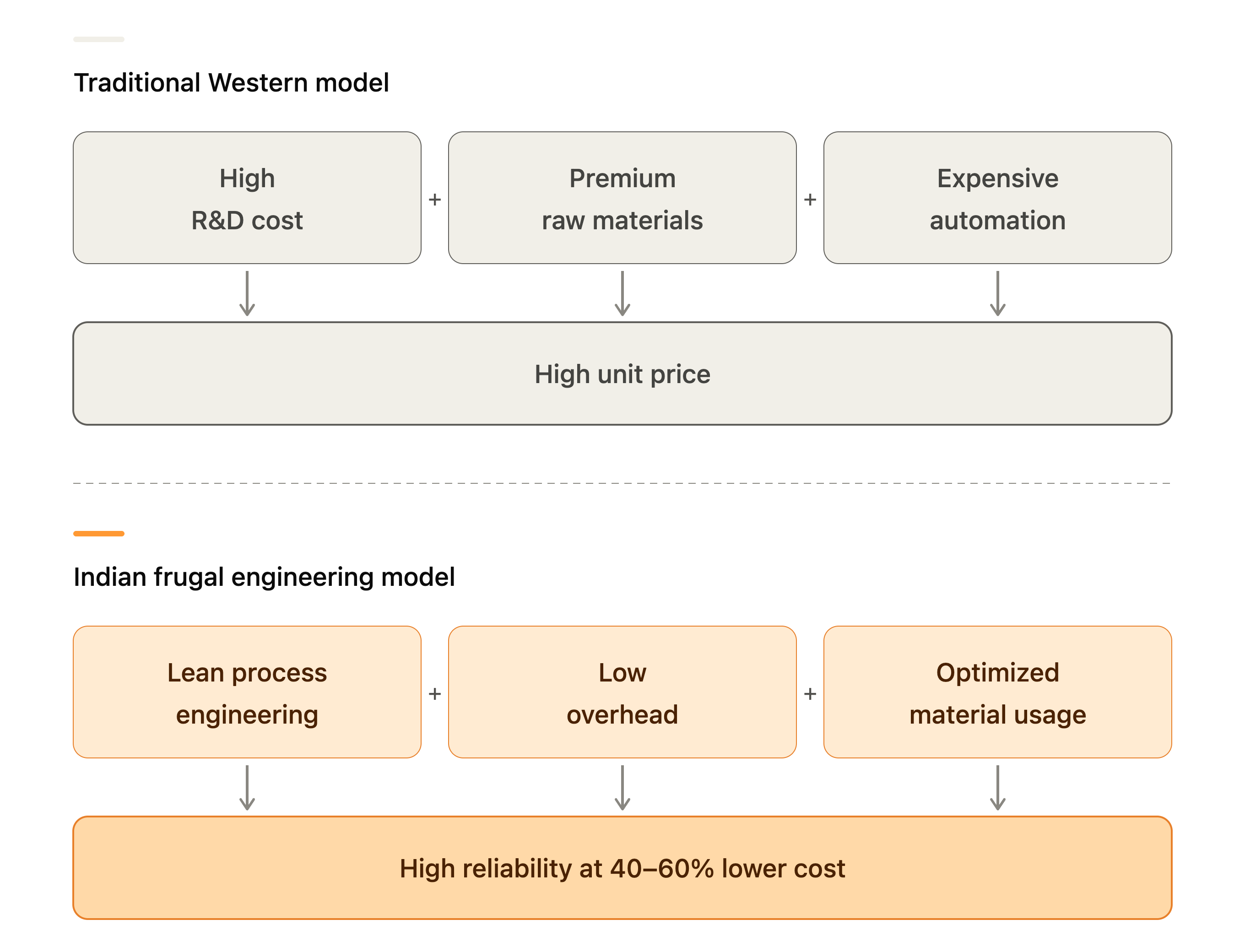
This forced Indian factory owners to master a discipline known as Frugal Engineering.
Take a standard industrial pump or an oil & gas pressure vessel:
- An Italian or German manufacturer will design a heavy-duty unit using ultra-expensive proprietary alloys and custom automated tooling. The product is superb, but it carries a 300% premium and massive corporate overhead.
- An Indian manufacturer in Gujarat or Tamil Nadu will re-engineer the manufacturing process using lean tooling, local high-grade metallurgy, and optimized shop-floor cycle times.
The final product delivers 95% to 98% of the performance and lifespan of the European benchmark, but at 40% to 60% of the cost.
For example, an American engineer sourcing a reliable steam trap might instinctively turn to Spirax Sarco or SAMSON, even though Forbes Marshall offers comparable performance at 40% of the price.
In critical process industries like power plants, water treatment, and refineries—where equipment runs 24/7/365 and downtime costs millions—Indian hardware wasn't just cheap; it was battle-tested in the world's most unforgiving domestic market.
The China + 1 Reality
For decades, the global supply chain was running on a single engine: China.
Between 2000 and 2020, every major Western procurement manager placed all their eggs in the Chinese basket. But over the last five years, three massive structural shocks completely shattered that strategy:
- Geopolitical Risk & Tariff Volatility: Escalating trade wars and rising import tariffs made single-country dependency a massive board-level liability.
- Soaring Labor Costs in East Asia: As China transformed into an upper-middle-income economy, factory wages rose significantly, eroding its historical cost advantage for low-to-mid-tier industrial manufacturing.
- Supply Chain Fragility: The moment a single region locks down or faces maritime disruption, global production lines across Europe and North America grind to a total halt.
This gave birth to the "China + 1" strategy—the urgent corporate imperative for Fortune 500 companies to build an alternative manufacturing base.
When global brands looked at alternative destinations like Vietnam, Malaysia, or Mexico, they ran into a wall: These countries are exceptional at final assembly, but they lack deep raw material processing and heavy component manufacturing. They still have to import raw steel, castings, and forgings from China.
India is one of the few nations on Earth with a complete, end-to-end industrial ecosystem: from raw iron ore mines and massive steel mills to advanced precision machining and software-integrated automation.
The Great Indian Bottleneck: The Export Readiness Gap
If India has the raw materials, the engineering talent, and the cost advantage, why isn't India already the default factory of the world?
This brings us to the core problem: The friction between domestic excellence and global export readiness.
Here is how the ground reality works:
Imagine a factory in Pune that has been manufacturing specialized industrial gaskets and valves for 32 years. They supply directly to Tata Power, Reliance Refineries, and Larsen & Toubro. Their quality checks are ruthless, their metallurgical standards are pristine, and their prices are remarkably competitive.
However:
- Their website looks like it was built in 2005.
- Their product catalog is a scanned PDF with inconsistent technical terminology.
- They don't have a multi-lingual sales team or an international trade compliance department.
- Their founder spends 100% of his time on the shop floor, not running LinkedIn campaigns or attending trade expos in Hannover or Chicago.
When a German or American procurement officer searches online for suppliers, this world-class factory doesn't even show up.
Instead, the Western buyer finds an aggressive trading company or a glossy middleman who marks up the price by 150%, delivers poor customer service, and destroys the buyer's trust in "Made in India."
This creates a massive market failure:
- The best Indian manufacturers remain hidden from global buyers.
- Global buyers end up paying overinflated prices to middlemen or falling back on expensive European suppliers.
The Business Opportunity: Bridging the Sourcing Gap
This brings us to the ultimate strategic question: How do you unlock a fragmented, highly capable market like India?
Sourcing successfully from India isn't about opening a web browser and picking the top search result. It requires a complete shift from "searching" to "deep verification."
To capture the value of Indian manufacturing, leading global sourcing firms and specialized aggregators operate on a strict 4-step framework:
- FILTER: Separate genuine Original Equipment Manufacturers (OEMs) from traders using on-ground physical audits, shop-floor capacity checks, and vendor registries.
- TRANSLATE: Convert vague global buyer RFQs into precise Indian manufacturing standards (matching IS/BS/ANSI/DIN specifications) and standardize CAD/CAM documentation.
- QUALITY ASSURE: Deploy third-party metallurgical and dimensional quality checks before the goods leave the factory floor, ensuring zero-defect export compliance.
- STREAMLINE LOGISTICS: Provide end-to-end door-to-port export documentation, clearing customs barriers and eliminating friction for overseas procurement departments.
Companies that master this bridging mechanism—like Sigma Industrial Solutions—don't just sell industrial parts; they eliminate the search friction for global trade.
By acting as a trusted operational layer over India's manufacturing landscape, they allow an overseas buyer in Dubai, Frankfurt, or Houston to tap into 30 years of Indian engineering pedigree with the same ease as ordering from a local supplier.
Business Lessons for Entrepreneurs & Procurement Leaders
- Look Beyond Brand Polish: The most competitive and capable manufacturing partners in emerging markets rarely have the best marketing budget or the flashiest website. Evaluate shop-floor capability, not marketing collateral.
- Cost is the Hook, Capability is the Moat: Never enter a new sourcing destination purely for cheap labor. Labor rates fluctuate; engineering culture, raw material access, and process optimization are what generate long-term margin.
- The Value is in Solving Friction: The biggest business opportunities today aren't in manufacturing new products from scratch—they are in building trust layers, verification systems, and bridge networks that connect hidden, high-quality supply with high-demand markets.
What's your take?
For the last 30 years, global business schools and procurement teams have operated under a rigid, unwritten rule:
- Germany is for precision engineering.
- Japan is for zero-defect reliability.
- China is for massive scale and unmatchable speed.
And where does India fit into this mental map?
For most international buyers, India doesn't even make the first cut. If it does, it is seen strictly as an IT services hub or a back-office software engine—not a reliable manufacturing powerhouse.
And this exact misconception is creating one of the single biggest arbitrage opportunities in modern global trade.
If you are running a business or managing a supply chain, what is the biggest operational hurdle holding you back from expanding your vendor network into emerging markets like India? Is it quality control, communication gaps, or logistics compliance?
Let me know, and let's break down the mechanics together!